


News
Technology transforms the world · Integrity builds the future · Leading boundless possibilities
Characteristics and Applications of Digital Transistors
Category:
Release Date:
2025-03-26
I. Overview of Digital Transistors
A digital transistor, also known as a crystal transistor or Semiconductor A transistor is a semiconductor device with three differently doped regions—namely, the emitter, base, and collector. This device plays a crucial role in electronic circuits, commonly used for amplification, switching, and voltage regulation. The structure of a digital transistor and… Working principle Relatively complex, but its core lies in controlling the base. Electric current This enables control of the collector current, thereby facilitating the processing and conversion of circuit signals.
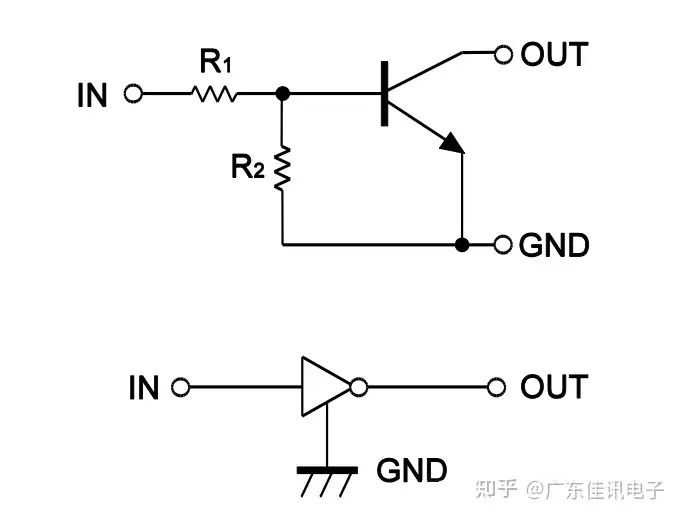
A bipolar transistor typically consists of a P-type base region, an N-type collector region, and an N-type emitter region (or a P-type emitter region, forming a PNP structure). When the base is connected to… Power supply At that time, the one connected to the base Resistor It limits the current to a very narrow range. At this point, the electric field between the emitter and the collector generates an electron cloud; under the influence of this electric field, electrons flow from the emitter to the collector, thereby constituting the current. By adjusting the base current, the collector current can be controlled, enabling the circuit to perform switching or amplification functions.
II. Operating Principle of the Digital Transistor
The operating principle of a digital transistor is based on the characteristics of a conventional bipolar transistor. Taking an NPN‑type digital transistor as an example, when a high voltage is applied to the base, the base current reaches a certain threshold. Under the influence of the electric field, the majority carriers—electrons—from the emitter diffuse extensively into the base region. Because the base is very thin and lightly doped, most of these electrons can continue to diffuse into the collector region and be collected by the collector, resulting in a substantial collector current. The transistor turns on, and the connection between the collector and emitter behaves like a closed switch. Conversely, when a low voltage is applied to the base, the base current is very small or zero, so only a negligible number of electrons diffuse from the emitter into the base, and the collector current is also nearly zero. The transistor turns off, and the connection between the collector and emitter behaves like an open switch.
III. Advantages of Digital Transistors
Digital transistors, with their distinctive performance characteristics, play an irreplaceable role in modern electronic circuits. The following are the key advantages of digital transistors:
3.1. Fast Switching Speed
Digital transistors have a faster response time because they typically operate only in the fully on (saturated) or fully off (cut-off) states. This rapid switching capability is advantageous for high-frequency applications. Digital circuit Especially important, such as computers. Processor and digital communication devices. In these applications, the digital transistor can respond rapidly to input signals. Signal changes, enabling high-speed data processing and transmission.
3.2. Low Power Consumption
When a digital transistor is in cutoff, it consumes virtually no power. In saturation, although current flows, the low voltage results in relatively low overall power dissipation. This characteristic makes digital transistors especially valuable in battery‑powered portable devices, as they help extend battery life and reduce energy consumption.
3.3. Simplification Circuit design
The use of digital transistors simplifies circuit design because they do not require complex linear control to adjust the amplification level. Designers need only focus on efficiently managing their switching states, without worrying about signal amplification or distortion. This reduces both the complexity and cost of circuit design while enhancing the circuit’s reliability and stability.
3.4. Logical Compatibility
Digital transistors can be directly interfaced with digital logic circuits, such as TTL ( Transistor - transistor logic) and CMOS (complementary metal–oxide–semiconductor) technology. This compatibility allows them to be easily integrated into complex digital systems, enabling seamless interfacing with other digital devices and Communication 。
3.5. High Integration
As Integrated circuit The advancement of (IC) technology enables the integration of a large number of digital transistors onto a single chip. This high level of integration not only saves space but also enhances the overall performance and reliability of circuits. Highly integrated digital transistor chips are widely used in electronic devices, such as… Microprocessor , memory and other digital circuit components.
3.6. Cost-effectiveness
Because the production of digital transistors has been highly standardized and automated, their manufacturing costs are relatively low. Moreover, their widespread use in digital circuits has enabled mass production, further reducing the cost per device. As a result, digital transistors have become an affordable electronic component, well suited for the manufacture of a wide range of electronic products.
3.7. Thermal Stability
Digital transistors exhibit good thermal stability in both the saturation and cutoff states. This is because, under these conditions, the device’s thermal characteristics remain relatively stable, preventing performance fluctuations due to temperature variations. As a result, digital transistors can maintain reliable operation even in high‑ or low‑temperature environments, making them suitable for a wide range of harsh operating conditions.
3.8. Easy to Test
Testing digital transistors is relatively straightforward, as they have only two states: on and off. This means the testing process can be carried out using simple binary logic, without the need for complex… Simulation Signal analysis. This reduces testing costs and time while enhancing production efficiency and product quality.
3.9. Wide range of applications
Digital transistors have a wide range of applications, including but not limited to computers, communication equipment, Audio and Video Equipment, Power Management Systems, among others. They play a critical role in areas such as signal processing, data amplification, and logic control. The diversity and flexibility of digital transistors enable them to meet the demands of a wide range of complex applications.
IV. Application Examples of Digital Transistors
4.1. Computer Processor
In computer processors, the digital transistor serves as a switching element in logic gate circuits. By controlling the on/off state of the base current, it enables logical operations and signal control. This makes the digital transistor an indispensable component of computer processors, responsible for performing a wide range of arithmetic and logical operations.
4.2. Communication Equipment
In communication equipment, digital transistors are used for signal amplification and modulation. They can amplify weak input signals and convert them into strong signals suitable for transmission. At the same time, digital transistors can also be employed for signal modulation and demodulation, enabling the transmission and reception of information.
4.3. Audio and Video Equipment
In audio and video equipment, the digital triode is used as an audio device. Amplifier and Radio frequency Amplifiers. They can amplify audio and video signals, enhancing both signal strength and clarity. This enables digital triodes to play a crucial role in audio and video equipment, such as sound systems, televisions, and projectors.
4.4. Power Management System
In power management systems, digital transistors are used for voltage regulation and current control. They can stabilize both output voltage and current, Protection circuit It is immune to voltage fluctuations and current overloads. This makes digital transistors highly versatile in power management systems, such as battery chargers, uninterruptible power supplies (UPS), and solar panels.
V. Comparison Between Digital Transistors and Ordinary Transistors
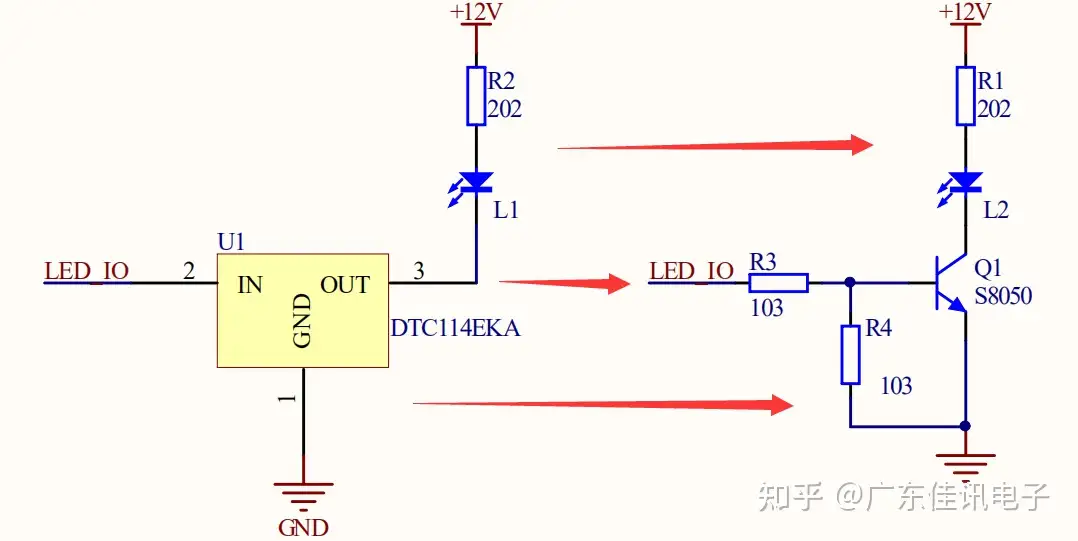
5.1 Simple Design: Circuit Principles The diagram is streamlined, especially for engineers. PCB During the layout process, every inch of PCB space—where every bit is at a premium—becomes especially valuable.
5.2 Cost Reduction: For a hardware development project Engineer Completing the circuit functionality of a project is the most fundamental task; for an outstanding senior hardware development engineer, it is also essential to consider the project’s design costs, such as R&D personnel expenses, Component BOM costs, PCB manufacturing expenses, and SMT assembly fees, among others; compared with conventional transistors, digital transistors can significantly reduce both BOM costs and SMT assembly expenses, because a digital transistor requires only three SMT solder joints, whereas a conventional transistor requires two. Resistance However, there are 7 SMT solder joints;
5.3 Circuit Reliability: As is well known, in a circuit system, the fewer components and chips used, the higher its reliability and the lower the probability of failure.
5.4 Logical Functions: In circuit design, digital transistors are typically operated in their cutoff and saturation states—i.e., the transistor is either off or on—allowing them to function as logic NOT gates. Electrical Function: To better serve our users, drawing on Chip Brother’s many years of R&D experience, the commonly used digital transistor models include the DTA114 series and the DTC114 series.
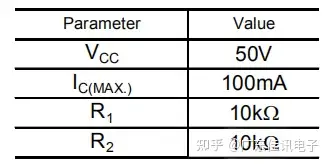
Key Parameter Table for Digital Transistors When selecting components, please pay close attention to the resistance values and their ratio between R1 and R2, as these two resistors significantly influence the circuit performance of the digital transistor. Engineers should choose appropriate values based on the specific requirements of the actual circuit design.
Common Models and Package Types
Common models : Such as DTC144EE, etc.
Package type : Mainly include TO-92, TO-92S, SOT-523, etc.
VI. Conclusions and Future Prospects
As an important semiconductor device, the digital transistor plays an irreplaceable role in modern electronic circuits. It offers numerous advantages, including fast switching speeds, low power consumption, simplified circuit design, logical compatibility, high integration, cost-effectiveness, thermal stability, and ease of testing. These benefits have led to the widespread adoption of digital transistors in fields such as computing, communication equipment, audio and video devices, and power management systems.
As Technology With continuous development, digital transistor technology is also steadily advancing and becoming more refined. Looking ahead, we can anticipate even greater breakthroughs in performance—such as higher operating frequencies, lower power consumption, and enhanced reliability. Meanwhile, the emergence of new materials and innovative manufacturing processes will further broaden and innovate the application domains of digital transistors. This will deliver more efficient, stable, and reliable electronic solutions to society, driving the ongoing evolution of electronic technology.
Keywords:
As an important semiconductor device, the digital transistor plays an irreplaceable role in modern electronic circuits. It offers numerous advantages, including fast switching speeds, low power consumption, simplified circuit design, logical compatibility, high integration, cost-effectiveness, thermal stability, and ease of testing. These benefits have led to the widespread adoption of digital transistors in fields such as computing, communication equipment, audio and video devices, and power management systems.
Contact Information
Guangdong Jiaxun Electronics Co., Ltd.
-
Address: Room 139, No. 8 Youxin Avenue, Wanjiang Subdistrict, Dongguan City, Guangdong Province
Mobile phone:18922939508
Phone:0769-2230 2199Fax: 0769-2315 8049
Email:jiaxundz@qq.com
QQ: 75836771, 343109788
Website:www.jiaxundz.com
WeChat consultation
WeChat consultation
If you have any questions, please contact us.
What services can we offer?
Copyright © 2026 Guangdong Jiaxun Electronics Co., Ltd. High-tech Enterprise: GR2019440006513Website Development: China Enterprise Dynamics Dongguan Tag


